
Coworking space vs Managed Office vs Conventional Lease.
Choosing the right workspace model can impact your costs, flexibility, and long-term growth. Explore the key differences between coworking spaces, managed offices, and conventional leases, with a practical framework to help you make an informed decision for your business.
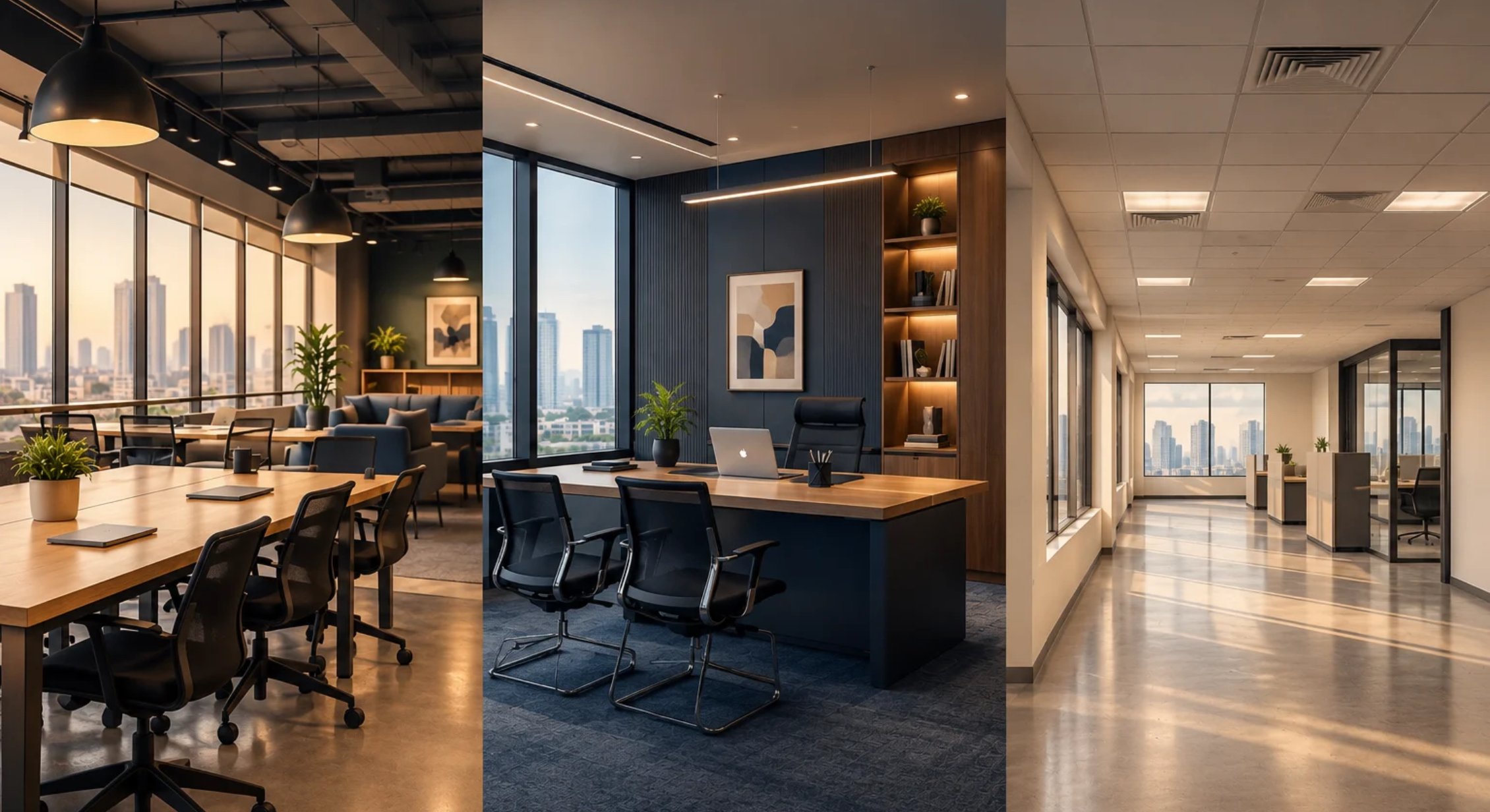
A Decision Framework
Choosing a commercial workspace used to mean signing a ten-year lease, hiring an interior designer, and spending months building out partitions and network infrastructure. Today, business leaders have far more options. Flexible commercial real estate now accounts for a significant share of office leases across major business hubs.
However, having more choices brings complexity. Companies must choose between coworking spaces, managed offices, and traditional leases. Selecting the wrong model can lock capital into rigid assets or force a fast-growing team into cramped, noisy environments. This guide breaks down each workspace model and provides a practical decision framework to help you choose the right setup for your business.
Understanding the Three Workspace Models
1. Coworking Spaces
Coworking spaces offer shared working environments where freelancers, startups, and small teams work side by side. Instead of leasing an entire building or floor, you rent desks, private booths, or small team rooms within a larger shared facility.
How it works
Coworking operates on a membership model. Members pay a monthly fee per seat or room. This fee covers high-speed internet, utilities, front-desk reception, security, coffee, cleaning, and shared meeting rooms. The space operator manages all day-to-day operations.
Common seating options
Flexi Desk (Hot Desk): First-come, first-served seating in open communal areas. Ideal for freelancers, remote workers, or hybrid staff who only need a desk a few days a week.
Dedicated Desk: A permanent, reserved desk in a shared room that remains yours every day. Ideal for solo professionals or small teams who want a consistent daily workstation without paying for a full room.
Private Cabin: Fully enclosed, lockable office spaces within the coworking facility. Ideal for teams that need privacy for phone calls and confidential work while still using shared building amenities.
Key advantages
Zero capital expenditure: You pay no upfront fit-out costs or infrastructure investments.
Short-term commitments: Contracts run month-to-month or year-to-year, allowing teams to scale desk counts up or down quickly.
Immediate entry: Teams can start working on the day they sign the agreement.
Key limitations
Limited privacy and customisation: You cannot brand the space or customise the office layout.
Variable noise levels: Open floors can introduce daily workplace distractions.
Higher cost per desk at scale: Per-desk pricing becomes expensive once the team size exceeds 30-50 employees.
Ideal fit
Coworking works best for early-stage startups, remote-first teams needing periodic desks, individual consultants, and enterprise branch offices testing new markets.
If you want to compare desk pricing and amenities across different locations, you can browse Truespace’s directory of verified coworking spaces to find the right fit for your team.
2. Managed Offices
A managed office is a fully customised workspace built specifically for your enterprise, but leased and maintained by a third-party flexible workspace provider. It combines the tailored experience of a traditional office with the operational simplicity of a flexible workspace.
How it works
The operator secures the property, designs the layout to meet your brand specifications, manages construction, and handles daily operation, all under a single monthly invoice. You get a private, fully branded workspace, whether you need a dedicated suite, an entire floor, or a standalone building, without taking on leasehold risks or building management.
Key advantages
Custom workspace design: Layouts, meeting rooms, IT infrastructure, and interior branding are built to your exact specifications.
No facility management work: The operator handles property management, vendor contracts, IT support, and utility bills.
Predictable monthly costs: All operational expenses, capital investments, and rent are consolidated into a single fee.
High privacy: Your company gets dedicated access control, private boardrooms, and secure network setups.
Key limitations
Medium-term commitment: Operators typically require a 1- to 33-year lease commitment to cover build-out costs.
Management fee: Service providers charge a fee above the base market rent for handling operational work.
Ideal fit
Managed offices suit mid-sized to enterprise businesses, Global Capability Centres (GCCs), and growing technology companies with 30 to 300 employees who want custom space without the distractions of managing a facility.
3. Conventional Leases
A conventional lease is the traditional model in commercial real estate. You lease bare-shell or warm-shell commercial space directly from a building owner or landlord for an extended duration.
How it works
You sign a long-term lease agreement, typically running 5 to 10 years. Your company is responsible for designing, building, furnishing, maintaining, and managing the physical space from scratch.
Key advantages
Lowest cost per square foot at scale: For large corporate headquarters and stable headcounts, conventional leases offer the lowest long-term cost per square foot.
Complete control over infrastructure: You have total authority over security protocols, physical access, interior design, and architectural choices.
Long-term stability: Secure long-term occupancy without risk of operator default or mid-lease relocations.
Key limitations
High initial capital expenditure: Fit-out costs, furniture, IT cabling, HVAC, and security systems require substantial upfront capital.
High operational burden: You must build or hire dedicated workplace management, facility, and administrative teams.
Rigid terms: Breaking a 5-year commercial lease carries heavy legal and financial penalties.
Ideal fit
Conventional leases suit established enterprises, financial institutions, and large corporate entities with stable headcounts (100+ employees) planning to occupy a space for 5 years or longer.
Decision Framework: Evaluating Your Workspace Needs
To choose between coworking, managed offices, and conventional leases, evaluate your company across five operational areas:
1. Capital Expenditure (CapEx)
If cash preservation is your main priority, avoid conventional leases. Coworking requires zero initial CapEx because all infrastructure is pre-built. Managed offices convert fit-out costs into monthly operating expenses (OpEx), spreading expenses over the contract term. Conventional leases require heavy upfront investment in design, furniture, and construction.
2. Team Size and Scalability
1-30 employees: Coworking offers optimal flexibility and cost efficiency.
30 to 200 employees: Managed offices deliver custom space without forcing you into long-term real estate liabilities.
200+ employees with a stable headcount: Conventional leases offer the lowest unit cost over a 5- to 10-year period.
3. Operational Bandwidth
Managing an office takes time away from core business operations. If your organisation lacks a dedicated real estate or facilities team, coworking or managed offices eliminate administrative burdens. Recent workplace studies show that companies increasingly favour third-party managed models to maintain focus on core business growth (JLL, 2026).
4. Branding and Security Requirements
If your business handles sensitive client data or requires strict physical compliance, shared coworking spaces may not meet your requirements. Managed offices and conventional leases provide private access control, isolated server rooms, and customised interior branding.
5. Growth Predictability
If your team size could double or shrink within 12 months, do not sign a 5-year agreement. Choose short-term, flexible agreements that align with your business planning cycle.
Workspace Model Comparison
1. Coworking Space
- Typical Contract Term: 1 to 12 months
- Upfront CapEx: Zero
- Setup Time: Immediate (1 day)
- Custom Branding: None
- Facility Management: Handled by the operator
2. Managed Office
- Typical Contract Term: 1 to 3 years
- Upfront CapEx: Zero to low
- Setup Time: 30 to 60 days
- Custom Branding: High
- Facility Management: Handled by the operator
3. Conventional Lease
- Typical Contract Term: 5 to 10 years
- Upfront CapEx: Very high
- Setup Time: 90 to 180 days
- Custom Branding: Full control
- Facility Management: Handled by the tenant
Conclusion
Selecting commercial office space comes down to balancing flexibility, control, and cost. Coworking gives early-stage teams immediate flexibility without commitments. Conventional leases provide stability and control for established corporations. Managed offices bridge the gap by giving growing businesses fully customised, private workspaces without the hassle of building maintenance and long-term lease liabilities.
At Truespace, we help businesses find and secure the right workspace model for their specific growth stage. Whether you need flexible desks for a project team, a customised managed floor, or a long-term commercial lease, Truespace simplifies your office search by connecting you with verified workspace options in prime commercial locations. Assess your headcount plans, budget structure, and operational bandwidth today to select a workspace that supports your business goals.
Visit truespace.work